The Mother's symbol: Difference between revisions
Jump to navigation
Jump to search

No edit summary |
No edit summary |
||
| Line 23: | Line 23: | ||
==External links== | ==External links== | ||
*[http://integralyoga-auroville.com/gilles-guigan/87-the-matrimandir-and-the-mother%E2%80%99s-symbol The Matrimandir and the Mother’s Symbol] - A short article by Gilles G. | *[http://integralyoga-auroville.com/gilles-guigan/87-the-matrimandir-and-the-mother%E2%80%99s-symbol The Matrimandir and the Mother’s Symbol] - A short article by Gilles G. | ||
<hovergallery> | |||
File:Savitri Bhavan 2018 - Divine Flowers 2.jpg | |||
File:2013 Life Education Centre 5.jpg | |||
</hovergallery> | |||
<br> | <br> | ||
[[Category:Archetypes, religion and philosophy]] | [[Category:Archetypes, religion and philosophy]] | ||
Revision as of 18:34, 6 July 2019

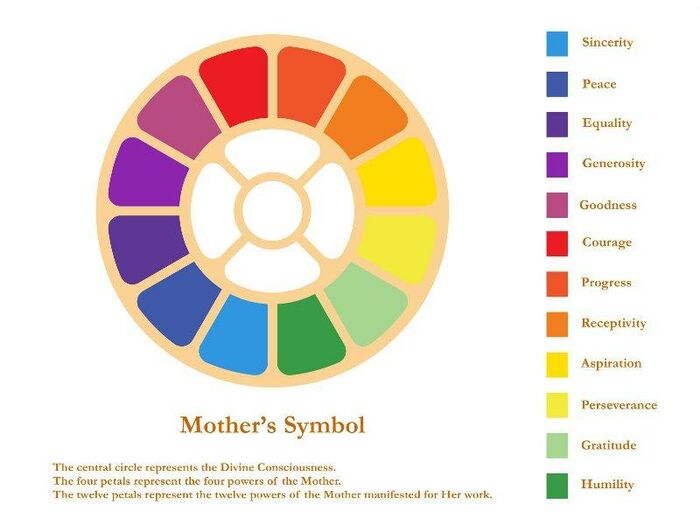
“Centre and 4 powers white. The 12 all of different colours, in three groups, (1) top group red passing through orange towards yellow, (2) next group yellow passing through green towards blue, (3) blue passing through violet towards red. If white is not convenient, the centre may be gold (powder).”[1]
“Essentially (in general principle) the 12 powers are the vibrations that are necessary for the complete manifestation. These are the 12 seen from the beginning above the Mother’s head. Thus there are really 12 rays from the sun, not 7, 12 planets etc."[2]

- ↑ The Mother with Letters on the Mother, p.597
- ↑ Ibid., p.598
See also
- Sri Aurobindo's symbol
- Ritam "The Twelve Petals of the Matrimandir" - article by Shanta Gowa
External links
- The Matrimandir and the Mother’s Symbol - A short article by Gilles G.

