SAIIER 2013:Sorcery at Sea: Difference between revisions
No edit summary |
No edit summary |
||
| Line 39: | Line 39: | ||
File:2013 Sorcery at Sea 4.jpg | File:2013 Sorcery at Sea 4.jpg | ||
</hovergallery> | </hovergallery> | ||
<br> | |||
[[Category:Reports 2013]] | |||
Latest revision as of 06:51, 12 January 2021
 Music for the Growing Soul |
 |
 Odissi Dance |
| Sorcery at Sea | ||
Note: For a full understanding of the production of this musical there is no better report/tool than the video that has been produced about the making of the production:
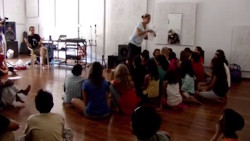

From March 21st for three nights, 54 Aurovillians (28 kids and 26 adults) from the ages of 7 to 74, performed a musical that was written and composed in Auroville. A back stage crew of 25 people supported the performance during those three days; playing the music, operating the lights, mixing the sound, applying the make-up, dressing the performers and providing the food and drinks needed to sustain the group.
For the previous 8 weeks this group had become a small community within the larger community of Auroville. Working with each other day in and day out, as the production came together from the initial auditions, drama rehearsals, song practice, set building and painting, costume design and making.
For the previous 9 months a much smaller group had been meeting to develop the story, write the script, compose the tunes and write the lyrics.
From the very beginning it was a collaborative effort, ideas coming from more than one individual and entering into the collective pool from where they evolved into the final script and music. As the date of the performance drew nearer and the circle widened, more ideas came and attached themselves to that which was already existing, with the final product presenting itself to the large community as the performance. A performance that was watched by three full houses in Bharat Nivas, a total of 2400 people.
The feedback from the community was instantaneous, with many people echoing an appreciation of the collaborative spirit and general good will amongst the performers and production team.
Theatre in itself provides for many educative processes that can enhance both children’s and adult’s skills. Learning lines for acting and singing, and learning choreography for dances are important skills to master. Being involved in a group that needs discipline and professionalism to create a performance gives a great lesson in life, showing that some small inconveniences are worth enduring so that the collective can create something beautiful and joyful.
Particular educative moments:
- Wow it is possible to create an entire production from scratch!: Both for kids and adults the experience of being in a production that is entirely created by people that you know is a liberating and empowering. It allows you to understand that it is possible, not some far off idea that other people do. For the kids in particular to see the way it works, changing the songs, modifying the lyrics, gives them the knowledge that it is possible to do oneself.
- Cooperative Collaboration: The experience of working in a large group, seeing how it is possible to find ways of building a harmonious production that incorporates the creative input of many artists and musicians is a learning experience for all involved. And when it is successful, as it was in this case, everybody involved learns about the ways to cooperate. Of course at times there are creative tensions, but the resolution of these situations is as much as a part of this process as the moments when everything moves along smoothly.
- Skill Sharing: The set construction and painting along with the costumes provided another avenue for very experienced people to become involved and share their skills. Top artists who exhibit their work all over India and in international exhibitions came to work on this production. To see how they work, and what they can create with very basic materials and in such a short space of time (10 days), was again an experience that teaches everyone what is possible with good will and a good atmosphere.
- Cooperative Stage Direction: When any person goes on stage, whether for the first time or for the fiftieth, they are exposing themselves to judgment. Moreover, in rehearsals they are at once expressing their interpretation of their role, but also allowing the director to mould their performance to suit the overall aesthetic of the production. People at this point are vulnerable and exposed, and it can be a traumatic experience if handled badly, particularly with novice performers. The production team was very aware of this situation, and thus used methods in the direction to ensure that all the performers felt supported and confident as they developed their roles.


